
The video itself is shot without the band Arcade Fire featuring at all. Normally within music video, more often than not, the band will be featured in a performance scenario or in an acting role. Within our video we want to provide a contrast between the narrative as well as the performance of the band to give a healthy balance as well as two different outlooks to keep the audience interested.

 The video itself features the life of everyday teenagers in their local area and the activities that they get up to - perhaps providing a microcosm for teenagers in general. They are shown riding their BMXs, firing BB Guns at each other and meandering about. In the video, there is a military aspect where the army instill marshall law in the town which shows the difference between the innocence shown by the teens in the video and then later highlights this loss of youth innocence as the army take this away from them.
When looking at this video, the loss of innocence is not important in terms of our research as we want to show how the youth can be presented as nothing but teenagers in their normal everyday life. So by focusing on Spike Jonez's portrayal of this, we can be inspired as to how to show the youth in our video which is titled 'Young Blood'. It is our plan to also show young people in events such as around a campfire, walking through the woods and on bikes for example, similar to the Suburbs video.

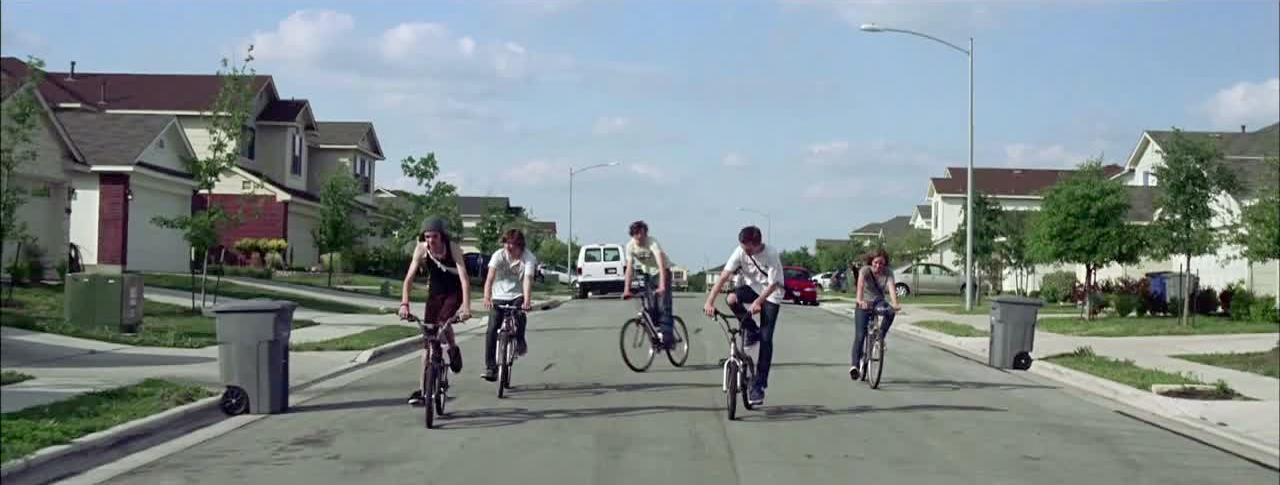
 The first shot is of a boy walking in front of a rather suburban setting, which immediately introduces the viewer to the characters' surroundings. This is then repeated in a long shot of all the teenagers riding their bikes through a typical American housing estate. The camera then tracks alongside one of the characters who again is stereo typically presented wearing a beanie hat and vest, symbolic of casual teenage wear. At this time the lyrics say "In the suburbs, I used to drive", which can be seen as a literal and iconic representation of bike riding as it is so familiar for a young person in the childhood. Jonez then carries on to show their friendship and youthfulness as they jump off their bikes and let it ride away before celebrating with each other at the achievement of the bike continuing to stand without them on it. It depicts the simple things that make a teenager happy and are integral parts of their life. We want to rein-act these simple events and show the joy of being a young person in our music video ultimately.

The next scene shows the group on top of a bridge firing their BB Guns at a stranger and then laughing in a medium shot. Whilst this is happening, two of the characters are aside of this and are shot in a close-up intimately- showing young love and romance as a normal part of growing up and how innocent love is endearing. Here we see two components of teenage life happening alongside one another, love and fun. The romance side of thing we want to be represented within our video and this can be seen hopefully in the camp fire scene with couples spread out around it in quite a cliche situation. Spike Jonez shows these as he himself is quite young for a director and therefore has these memories fresh in his memory. As we (our group) are still this age we are living through them right now, therefore our representation should be even more accurate than his, so theoretically ours could be more credible.

Although it is a complicated video, when you take away the involvement of the army, the core of the video is teenage experiences and within our video 'Young Blood' we want to demonstrate this. The opening lyrics set the platform for what is to unfold in the video -"We're all young and naive still, we require certain skill". We want to let this curiosity of a teenager be shown and them developing their life experiences - which reiterates the gaining skills message.


