The Suburbs (Arcade Fire)) directed by Spike Jonze.
The video itself is shot without the band Arcade Fire featuring at all. Normally within music video, more often than not, the band will be featured in a performance scenario or in an acting role. Within our video we want to provide a contrast between the narrative as well as the performance of the band to give a healthy balance as well as two different outlooks to keep the audience interested.
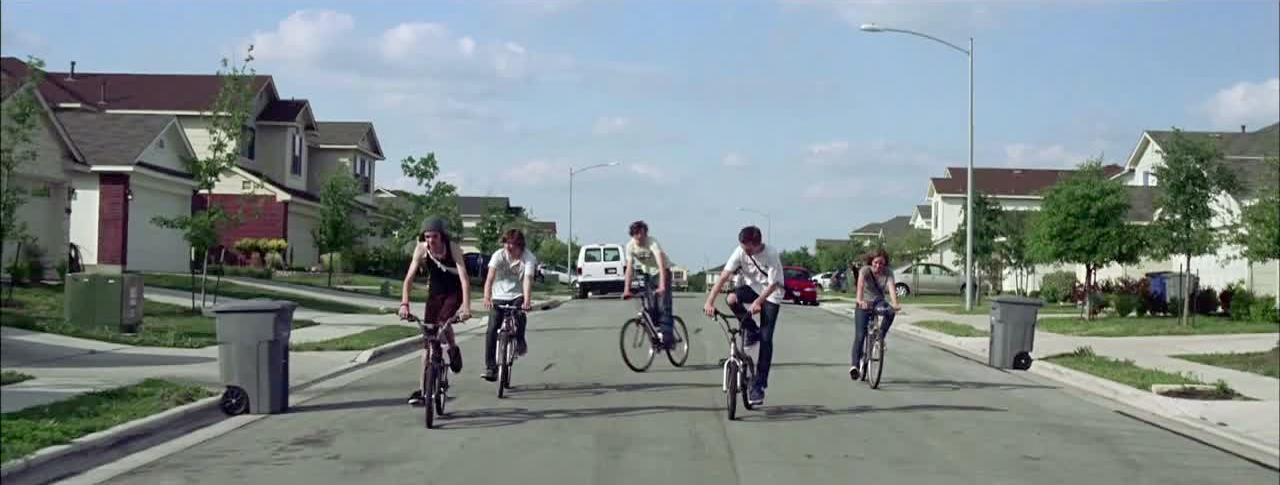
The video itself features the life of everyday teenagers in their local area and the activities that they get up to - perhaps providing a microcosm for teenagers in general. They are shown riding their BMXs, firing BB Guns at each other and meandering about. In the video, there is a military aspect where the army instill marshall law in the town which shows the difference between the innocence shown by the teens in the video and then later highlights this loss of youth innocence as the army take this away from them. When looking at this video, the loss of innocence is not important in terms of our research as we want to show how the youth can be presented as nothing but teenagers in their normal everyday life. So by focusing on Spike Jonez's portrayal of this, we can be inspired as to how to show the youth in our video which is titled 'Young Blood'. It is our plan to also show young people in events such as around a campfire, walking through the woods and on bikes for example, similar to the Suburbs video.
The first shot is of a boy walking in front of a rather suburban setting, which immediately introduces the viewer to the characters' surroundings. This is then repeated in a long shot of all the teenagers riding their bikes through a typical American housing estate. The camera then tracks alongside one of the characters who again is stereo typically presented wearing a beanie hat and vest, symbolic of casual teenage wear. At this time the lyrics say "In the suburbs, I used to drive", which can be seen as a literal and iconic representation of bike riding as it is so familiar for a young person in the childhood. Jonez then carries on to show their friendship and youthfulness as they jump off their bikes and let it ride away before celebrating with each other at the achievement of the bike continuing to stand without them on it. It depicts the simple things that make a teenager happy and are integral parts of their life. We want to rein-act these simple events and show the joy of being a young person in our music video ultimately.
The next scene shows the group on top of a bridge firing their BB Guns at a stranger and then laughing in a medium shot. Whilst this is happening, two of the characters are aside of this and are shot in a close-up intimately- showing young love and romance as a normal part of growing up and how innocent love is endearing. Here we see two components of teenage life happening alongside one another, love and fun. The romance side of thing we want to be represented within our video and this can be seen hopefully in the camp fire scene with couples spread out around it in quite a cliche situation. Spike Jonez shows these as he himself is quite young for a director and therefore has these memories fresh in his memory. As we (our group) are still this age we are living through them right now, therefore our representation should be even more accurate than his, so theoretically ours could be more credible.
Although it is a complicated video, when you take away the involvement of the army, the core of the video is teenage experiences and within our video 'Young Blood' we want to demonstrate this. The opening lyrics set the platform for what is to unfold in the video -"We're all young and naive still, we require certain skill". We want to let this curiosity of a teenager be shown and them developing their life experiences - which reiterates the gaining skills message.
'Walk' is the single from American band Foo Fighters and was released on June 6th 2011. The song reached number one on the Billboard Chart. On February 12th 2012, the song won two awards at the Grammys for 'Best Rock Performance' and 'Best Rock Song'. In the music video 'Walk', lead singer of the Foo Fighters, Dave Grohl, takes the character of a stressed out businessman on his way to work. He becomes increasingly frustrated at the path is life is taking whilst sitting in traffic and decides to dramatically change the status quo and go back to the old school of rock and roll. It is as if he is having a midlife crisis. Dave Grohl is pictured through a long shot sitting in his car looking fed up. He is dressed in a standard yet sterile white shirt and tie with glasses - stereotypically the uniform of the average working man. A series of close ups and cuts show how he increasingly gets more and more annoyed. The surroundings reflect how society has changed around him - "PUNK IS DEAD" written in graffiti above him on a bridge. Other examples are a number of bumper stickers such as "Thankyou President Bush" and "Coldplay". Grohl sees what is wrong through his eyes in society and realises he has been caught up in these changes and himself changed into this mundane everyday existence. He grabs his guitar and exits his car - symbolic for his exit from this boring lifestyle. He is not a businessman, but a rockstar. When he leaves the car the music begins. Grohl immediately refers to this dull existence in the lyrics therefore showing a direct relationship between the lyrics and the visual meaning of the music video, "To who it may concern, I think I may have lost my way, getting good at starting over every time I return". It echoes this idea of him losing contact with what is important which can be presumed music perhaps. As these words are being spoken, the camera tracks him walking along a bridge. There again is repetition of the literal translation of the lyrics as not only is he metaphorically learning to walk again but physically too as he has left his car behind. It as if Grohl realises he has been 'going through the motions'.
He goes from one mishap to another in the video. At first his stumbles across a newsagents and asks to use the phone but he rudely is denied his request and comically has a plunger pushed into his face. The pace of the events on screen becomes more dramatic as the heavy guitars start and he assaults the attendant before running out of the shop. The lyrics then sung are, "Do you remember those days we built paper mountains, then sat and watched them burn" - suggesting that the spirit of adventure and rebelling has gone. As this is being sung, Dave Grohl pushes over a phonebox, which repeats this idea of fighting against the system.
It shows the transition form his normal lifestyle which was initially presented to how he is now trying to break away from this. It is a protest against morality and the limitations that society forces onto you. This is also then shown again when he is threatened for his guitar, perhaps as he looks vulnerable dressed as a stereotypical business man as mentioned. The two attackers are clothed again stereotypically as thugs in dark and threatening props. A comical fight scene then takes place which also can be seen to reflect Dave Grohl's personality which is not too much of a serious one. This is also a feature of the band itself - as the members feature as characters throughout illustrating they do not take themselves too seriously as well. This happens to take place in a park which is an everyday surrounding, much like the city landscape which is featured throughout as a constant. This is also the same for the golf course where Dave continues his mishaps by stealing a golf buggy and running over one of the players as well as driving it into a lake. It generates an atmosphere of chaos and anarchy. Again, this is not meant to appear as a violent event, but a comical one - but at the same time showing the frustration at society he feels. The lyrics at this point are almost shouted intensely which is emphasized through the angry expressions etched upon Dave's face - "I never wanna die" is repeated.
When Grohl arrives at the garage branded with the Foo Fighters emblem, he enters and is shot in mid framing. His band members are then shot for the first time together and then it cuts back to him - by taking off his glasses and loosening his tie, it metaphorically represents him freeing himself from the shackles which conceal his true identity, which is an old school rock star. This part of the video shows the change between the comical narrative and the actual performance where he is presented in the foregrounded as the lead singer. The performance is shot in a series of fast cuts which plays off the beat of the song hence the pace of the transitions. It focuses on every member of the band before frequently flitting back to Grohl on his own. Unlike Grohl the bandmembers such as Taylor Hawkins (drummer) are not still dressed in the same clothes as they were earlier in the video. They are wearing casual clothing which can be seen as them being normal and themselves as a member of the Foo Fighters. It then cuts at the end to the police storming in and tazering Grohl. Which again appears halarious to his bandmates and concludes the video which subconsciously portrays a meaningful message of how society is changing for the worse.
'Stan' by Eminem, directed & produced by Philip Atwell & Dr.Dre was released in December 2000. It reached No.1 in both the UK and Australia and the video was then released 2 years later in 2002 and was received just as well as the track. It has being nominated for Video of the Year, Best Rap Video, Best Direction & Best Cinematography at the MTV Video Music Awards. I personally feel a.particular reason for its success is the intelligent lyrics which are then followed by the director closely in the video to create a personal and believable translation of events. Stan is a obsessed fan who idolises Eminem. He is a bitter and intense man due to the neglect he claims he has recieved from Eminem after the star has failed to respond to his fan mail. This subsequently drives him mad and the video shows his journey to madness as a result of not having his love reciprocated. Stan's girlfriend's love is not enough for him, and is entirely focused on Eminem and almost shuns her attempts throughout to win him back and in the end her life is over as a result of her boyfriend's actions. The video has many controversial parts within including him committing suicide and also killing his pregnant girlfriend. It adds to the drama of the video in a story telling like fashion. It is a performance within a narrative as the video feeds off the lyrics of the song as the words are part of the letters written to Eminem and visa versa. The controversy and detail that the video goes into and the literal translation of the lyrics into a story makes it very realistic and almost haunting.
The video starts with Stan centered in a rough looking bathroom, standing over a sink dying his hair blonde - instantly identifying his obsession with Eminem. He looks up into the mirror in a close up shot and we are introduced for the first time to the protagonists appearance. The are flashes of lightning and eerie chords in the background, setting the scene (using pathetic fallacy) for a dark video. Dido is then introduced as his pregnant girlfriend in a tracking shot which almost makes the events seem real as she is featured as she is singing e.g.)"My tea's gone cold I'm wondering why I.. got out of bed at all. The morning rain clouds up my window.. and I can't see at all". These lyrics directly link to the weather unfolding outside at the time showing again this relation between visuals and lyics. Stan's fragile state of mind is then indicated again as he shouts at his girlfriend for calling him Stanley, "Don't call me that!" he screams despite the fact she is in a fragile condition herself. There is a sequence of cuts and aerial shots showing the environment they're in. Pathetic fallacy is then repeated with the audio enhancement of the rain with a Dido track blended over the top. Eminem is then pictured and then it goes back to Stan, showing the contrast between the two. The camera tracks Stan to his basement, which I feel represents his insanity as it is so dark and this is also enhanced with the surroundings - hundreds of pictures of the rapper pasted on the walls. The camera pans round Stan whilst he is writing the letters as he is so transfixed at a low angle showing his agitated expression. You can see the concentration etched on his face through the close up and mid shots of him in his chair. Again the lightning brightens up his face presenting him as a threatening and scary character - stereotypically in horror films. There are many sound effects within the video. Little insertions of these such as the scribbling noise of the pencil and the screech of tires heighten the narrative and the way the production is recieved by the audience - making it seem more like a film perhaps than a music video.There is also a lot of fading up from black as well jumping between events such as the present and then his letter in the post to represent an ellipsis of time. The video then shows his memories involving Eminem and showing how he was let down thus explaining his anger at the lack of interest on Eminem's part - an example of this is him "waiting in the freezing cold for 4 hours" and it shows him waiting for Eminem with his brother who are then ignored. Another example of this is where he meets Eminem at a book signing where Stan hugs him with adoration demonstrating his 'love' for Eminem.
There is a constant relation between the lyrics and the story on screen.. as if it is a direct recorded account of all the events therefore the video is built around the actual narrative. This was another major part of the video as you watch Stan get progressively more frustrated and mad. The notion of looking is used throughout so that the protagonist's emotions are visible and the watcher can almost empathize with him. A prime example of this is when Stan looks into the mirror and sees Eminem staring back - it again shows his idolisation and desire to be just like him. The pivotal part of the video in my opinion is where there is a shot of only his hands and a photo of him and his girlfriend ; and he pastes a picture of Eminem over her so in the photo they are next to each other. It shows the seriousness of his insanity and obsession. Again at this point the lightning has still remained as a constant throughout, echoing his fragile state of mind. Stan is then framed in a close up in his car recording a message on a tape which again is the lyrics of the song. He appears distraught and this is also enhanced by the weather. The rain is repeated again as this is the climax of the play. A picture of Eminem hangs from the mirror in the car showing his absolute devotion and idolization of the star.The car is edited going over the side of the bridge in slow motion to make Stan's exit even more dramatic. All through the video, the lyrics and images on screen crescendo to this final part of Stan's life where he has resulted to such extremities. He is shot in the car in a close up view to show the desperation etched upon his face along with two other angles which are alternated - "I'm doing 90 on the freeway". When the car is pulled out from the lake which is uncovered on the news channel, the news reporter's voice eclipses the track so the reality of what has happened becomes evident. When Eminem is replying to the letter and he clocks what has happened, he is shocked and taken back by what he has just realised and that he is possibly to blame. The notion of looking is used to show his reaction and dismay at the situation which he possibly could have prevented. The use of a mid shot allows this to be seen as he looks out of the window in disbelief."You could've saved me from drowning".
This is a different style compared to Eminem's other videos. Although they are a literal translation on screen in therms of the video's relation to the lyrics but this is specified to Stan the main character. Although he features in it sometimes, the whole video is based on somebody else. Most of his songs are written about his life experiences so his presence in the videos is imperritive. It is said though that his life experiences influenced the video of 'Stan' after his Uncle Ronnie also committed suicide - he is also mentioned in the song. Other intertextual references include links to other songs he has written such as "97 Bonnie and Clyde" where the lyrics in 'Stan' say "If I have a daughter, guess what im'a call her? Im'a name her Bonnie". By making links to his work, he can cross promote his other songs as well as relate the lyrics to his personal life despite them only being subtle references.


 The video itself features the life of everyday teenagers in their local area and the activities that they get up to - perhaps providing a microcosm for teenagers in general. They are shown riding their BMXs, firing BB Guns at each other and meandering about. In the video, there is a military aspect where the army instill marshall law in the town which shows the difference between the innocence shown by the teens in the video and then later highlights this loss of youth innocence as the army take this away from them.

 The first shot is of a boy walking in front of a rather suburban setting, which immediately introduces the viewer to the characters' surroundings. This is then repeated in a long shot of all the teenagers riding their bikes through a typical American housing estate. The camera then tracks alongside one of the characters who again is stereo typically presented wearing a beanie hat and vest, symbolic of casual teenage wear. At this time the lyrics say "In the suburbs, I used to drive", which can be seen as a literal and iconic representation of bike riding as it is so familiar for a young person in the childhood. Jonez then carries on to show their friendship and youthfulness as they jump off their bikes and let it ride away before celebrating with each other at the achievement of the bike continuing to stand without them on it. It depicts the simple things that make a teenager happy and are integral parts of their life. We want to rein-act these simple events and show the joy of being a young person in our music video ultimately.